Scientists from FFWT MENDELU participate in conservation of the Morvan Nature Park in France
16. 1. 2023
At the French archaeological site of Bibracte, scientists from the Department of Geology and Soil Science of the FFWT MENDELU are participating in European research. Their aim is to propose suitable measures for the conservation and adaptation of the local forests. The site is located within the territory of the Morvan Nature Park and includes the massif of Mt. Beuvray and also an important ancient Celtic oppidum, which was even mentioned by Julius Caesar in his writings. To this day, the location has preserved the character of the ancient foothill rural landscape with a mosaic of forest, agricultural land and bodies of water. A diverse scientific community is striving to preserve it.
“Within the Forestry Lab Bibracte project, in which the National Forests of France, the University of Dijon, the University of Orléans and the Morvan Natural Park are all involved, our specific task is to obtain information on the soil cover and other abiotic factors affecting the current forests over a large area of almost 900 ha of the Bibracte massif so that we can propose appropriate measures for their conservation and adaptation,” explains Aleš Bajer, who as a geoarchaeologist has already participated in archaeological excavations in the Celtic oppidum of Bibracte.
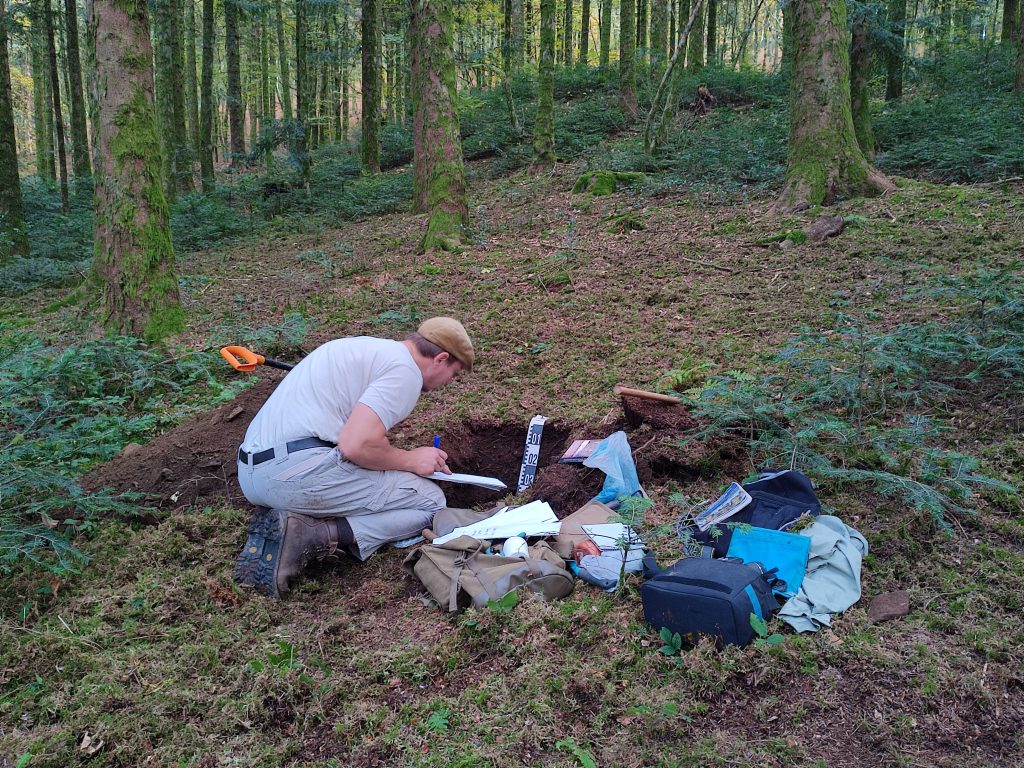
Last year, researchers dug 21 classic soil probes, which they also fully described, and soil analysis is now underway. Meteorological stations were placed at three locations, which continuously measure temperature and humidity at three depths within the soil and two meters above the ground. The data obtained will form the basis for determining appropriate measures in the Bibracte forest complex, so that the character of the sparsely populated area, where people are engaged in traditional activities such as agriculture, forestry, tourism to some extent, and where there is no industrial production, is preserved and prospers.
“Our research is part of a more extensive research project that should contribute to the cultivation of forests on the territory of Bibracte that will be fully adapted to ongoing climate change. They will fulfil an economic function, but also other non-productive functions, e.g. soil conservation, water retention, and last but not least, the character of the entire archaeological site will be preserved. In other words, the genius loci of the area will be preserved,” says Bajer, underlining the significance of the research.
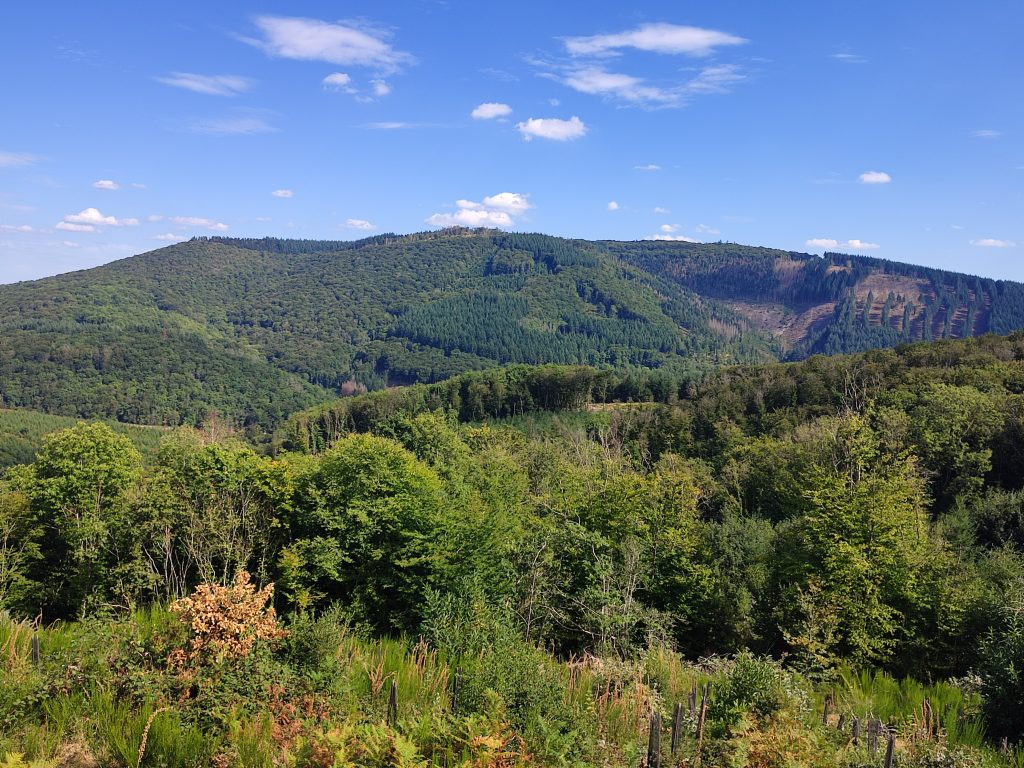
The current forest in the Bibracte massif can be divided into five groups: spruce monoculture, which has now been almost cut down, fir monoculture, sometimes with an admixture of Douglas fir (often dying), Douglas fir monoculture (often significantly damaged), in the upper parts there are bare beech trees (almost without renewal) and a mixture of deciduous trees – beech, oak, hornbeam, sometimes with an admixture of fir.
“The uniqueness of our research lies, among other things, in the fact that it is the first permitted non-archaeological intervention within the oppida, i.e. inside the walls. A number of samples have been taken for analysis, we believe that the results of the analysis will help us interpret the development of the oppida area after it was abandoned by the original inhabitants,” adds Bajer.
Description of the probe in the field
View of the forests of the Bibracte massif
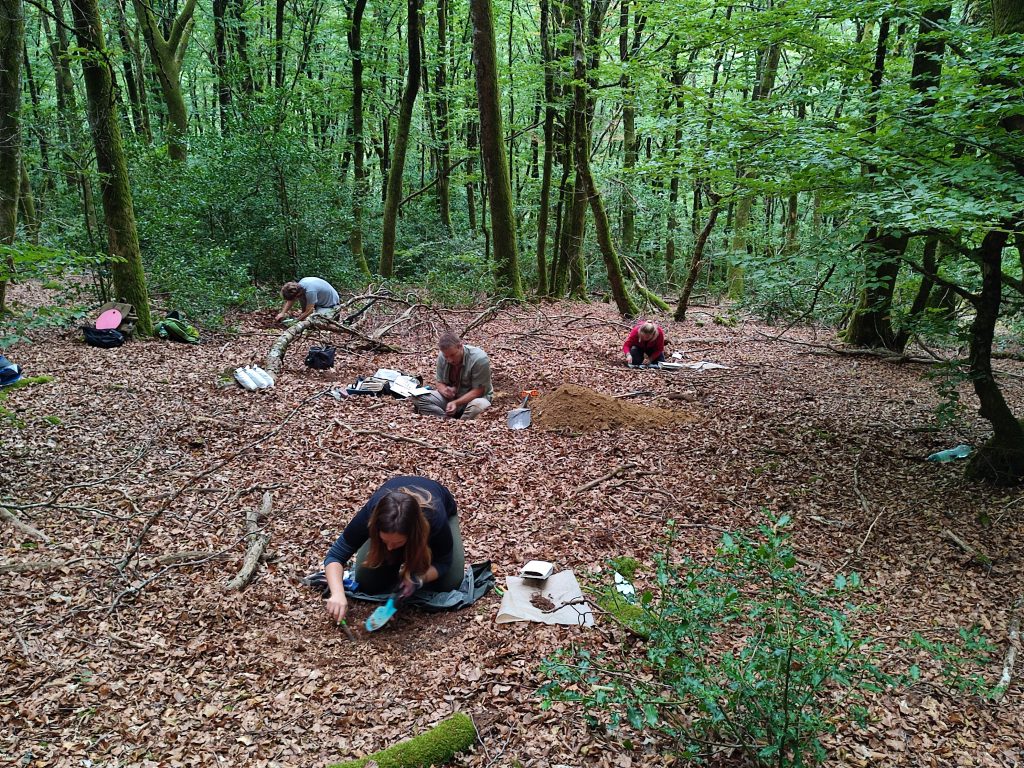
FFW team at work in the forest
A research stay at Bibracte is also interesting for scientists from the point of view of the work base and available research infrastructure. The host organization not only provides foreign teams with accommodation and the possibility of catering directly on the spot, but the scientists also have at their disposal functional laboratories, training rooms and a library that is open 24 hours a day.
“Collected field samples can therefore be partially processed directly in local laboratories and other necessary sources of information can be found in the local library,” says Marie Balková of the advantages of this work base. Balková is participating in the research as a specialist in geoinformation technology.
Further field research at the site is planned for late spring 2023. In addition to digging further soil probes, the scientists are also planning research into the light conditions of the studied sites.
The importance of the Bibracte location is also evident in it being awarding the status of “Grand Site de France” by the French Ministry of the Environment in 2007, which has so far been awarded to only a few dozen locations throughout France. This status is a guarantee that, within a given heritage-protected locality, there is harmony between environmental conservation, the needs of local residents and those of visitors.
Contact person for further information: Doc. M.Sc. Aleš Bajer, Ph.D., Department of Geology and Soil Science FFWT MENDELU, e-mail: ales.bajer@mendelu.cz, Tel: 775 331 666
We work with cookies. Why? We analyse traffic and events on the website so that we can continually improve it. We also need cookies to provide social media features and to customise the content of ads. With consent, we may also pass some personal information to marketing platforms for marketing purposes.
About Cookies
Cookies are small text files in which websites can store information about your activity on the website and user preferences. They are used, for example, to make the browser remember your login, the consent settings in the cookie bar and, with your consent, various marketing and analytical information.
Necessary
These cookies ensure the basic technical functionality of the website, are necessary for the proper functioning of this website and are always active.
Analytical
We use third-party tools to track traffic. According to Google Analytics settings, personal data may also be sent.
Preferential
They store your personal settings, such as the language in which information is displayed, or allow you to offer content tailored to your needs.
Marketing
We are using third-part marketing cookies and your personal data to show you content customized to what you have viewed on our website. The content can be viewed elsewhere on the Internet. You can disagree with using of our marketing cookies but it will not reduce the extent of advertising offers you see, you will only see more of uninteresting and irrelevant ad to you.