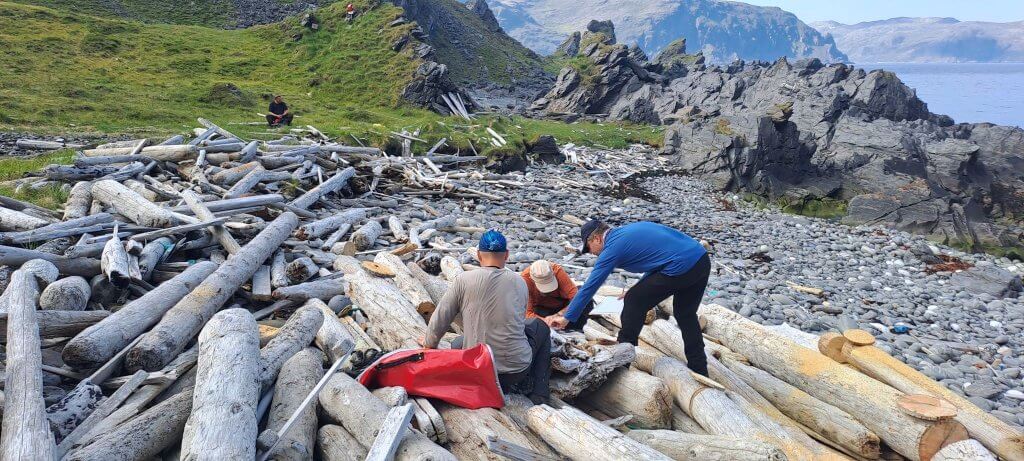
Scientists from FFWT MENDELU have completed a second mission in search of driftwood to the northern coast of Norway. As in 2022, they took samples of driftwood, which will be analysed in the MENDELU dendrochronological and anatomical laboratory. In total, they have at their disposal more than seven hundred tree samples, some of which may be up to 400 years old. The samples were taken in cooperation with Paul Eric Aspholm of the Norwegian research institute NIBIO, with whom our scientists have been cooperating for a long time. Among other things, the team aims to determine the age, type and origin of the wood, and how climate change, which relates to the massive loss of ice in the Arctic Ocean, affects the journey of the driftwood from its place of origin to the coast of Norway.
“A few years ago in Iceland, we found out that the driftwood on the shore mainly comprises of timber which fell into rivers in Siberia between the 1940s and 1970s, and very little younger timber is found there. One of the possible reasons for this, in addition to changes in methods of cutting and transporting timber in Siberia, is the loss of ice in the Arctic Ocean. Timber can only travel such a great distance if it is frozen and drifts in the sea ice. Otherwise, it sinks to the bottom of the ocean after a certain time,” explains Tomáš Žid of the Department of Forest Conservation and Wildlife Management.
The scientists intend to find out if Norway is now threatened by the same problem as that which Iceland is facing. In the dendrochronological laboratory, they will therefore measure the width of tree growth rings and compare the resulting tree growth ring curves with a database of tree growth ring chronology from the northern regions of Europe, Asia and America. Among other things, they will get an idea of the exact origin and type of wood. For freshly beached timber, this will help them determine the length of time the wood has been floating in the ocean.
“We also record whether the timber bears any signs of logging or transport, which means it was lost while being floated, or if the roots are still evident, which means that the tree got into the river in a natural way, without human intervention. The usual cause of trees falling into rivers is the spring thaw. At a high rate of flow, the water carrying large blocks of ice will erode the river banks, and trees will fall into the river,” explained Tomáš Kolář of the Department of Wood Science and Wood Processing Technology.
This year, the researchers have further increased the number of parameters studied. They are interested in the dimensions of pieces of timber, and the way driftwood accumulates on beaches. “We want to find out which beaches are more suitable for accumulating driftwood,” added Žid.
This year, the scientists have also taken radial bores from living Scots pine, as some of the wood could theoretically come from Norway. The samples will serve to build a new growth ring chronology database. Driftwood research will also contribute to the refinement and extension of reference chronology in the source areas of Nordic coniferous forests. Thanks to this, experts can get more accurate information on climate development in these areas and better understand the impact of climate change on the flow of driftwood in the Arctic Ocean.
Contact for further information: Ing. Tomáš Žid, Ph.D., Department of Forest Conservation and Wildlife Management FFWT MENDELU, +420 724 772 334, tomas.zid@mendelu.cz
The research project was supported by a bilateral initiative of EEA and Norway Funds (EHP-BFNU-OVNKM-4-107-2023).